Real-life stories of courage and purpose, taking listeners into the heart of the most complex social and political issues facing our world.
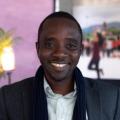
As a teenager, Chernor traveled the country listening to children's stories, including those from former child soldiers. His drive was simple: to include children's voices in Sierra Leone's peacebuilding process. In this episode, we talk about the civil war in Sierra Leone, issues surrounding girls' education, the Ebola outbreak and how Chernor is fighting to rebuild his country and advance girl's rights.
Chernor Bah
Global Girls Activist; Co-Founder of Purposeful; Member of the Global Partnership for Education
Dr. Zoe Marks
Lecturer in Public Policy, John F. Kennedy School of Government, Harvard University
Justine Sass
Chief of Section Education for Inclusion and Gender Equality at UNESCO
Key themes: Overcoming poverty, gender equality, girls education, youth in peacebuilding, social justice, Sierra Leone, African development
Also available on:
In this episode, we learn how Afghan women and girls are defying the odds of a patriarchal society, and the transformative power of STEM education to gain a foothold in one of the most conservative regimes in history.
Roya Mahboob
Serial entrepreneur, CEO and President of Digital Citizen Fund
Heather Barr
Acting Co-Director of Women's Rights Division at Human Rights Watch
Farangies Shah
Policy Advisor at Afghanistan Independent Human Rights Commission
Mina Sharif
Civil Society Activist, TV and Radio Producer.
Key themes: Afghanistan, Taliban and Womens' Rights under The Taliban, Religious Extremism, Robotics & STEM Education, Women's Empowerment, Entrepreneurship
Also available on:
Once settled in Europe, Sarah's efforts to provide emergency response and humanitarian aid for refugees resulted in charges against her. She spent 107 days inside a high-security Greek prison for alleged crimes including people-smuggling, spying, violation of state secrecy laws and money laundering. Large-scale social media campaigns and demands from European Government officials and leading human rights organizations advocated for Sarah's innocence, under the slogan "humanitarian action is not a crime." In this episode, we learn about the Syrian refugee crisis, the harrowing journey that many refugees take to find safety, misconceptions about migrants, and the complexity of humanitarian action.
Sarah Mardini
Elite Swimmer and Refugee Advocate, Time 100 Next List 2019
Sara Kayyali
Syria Researcher, Middle East North Africa Division, Human Rights Watch
Dr. Steven Heydemann
Janet W. Ketcham Chair and Professor, Middle East Studies, Smith College; Senior Nonresident Fellow, Brookings Institution Center for Middle East Policy
Bill Frelick
Director, Refugee Rights Program, Human Rights Watch
Key themes: Refugees, humanitarian action, Europe migration, crimes against humanity, humanitarian activism and advocacy.
Also available on:
In this episode, we learn about the colonial history of Yemen and the civil war that broke in 2015. We also talk about what Arab Spring meant for Yemen, the massive food insecurity caused by the country's ongoing conflict, and through Mokhtar's lens, how coffee and responsible farming practices can be used as a tool to unite and heal a population.
Mokhtar Alkhanshali
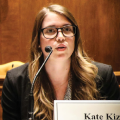
Kate Kizer
Policy Director, Win Without War; Former Director of Policy and Advocacy at the Yemen Peace Project
Kristine Beckerle
Legal Director on Accountability and Redress, Mwatana
Iona Craig
Journalist
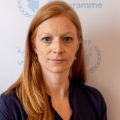
Annabel Symington
Yemen Head of Communications, World Food Programme
Key themes: Entrepreneurship and social innovation, Agriculture, Yemen War, Famine & Food insecurity, Coffee Culture.
Also available on:
In this episode, two former world leaders discuss multilateralism and why effective global partnerships are the best defense against existential threats, including the pandemic that we are facing today. We unpack the reasons for the diminishing levels of trust in public leadership and the paralysis that some believe is affecting the UN's ability to respond effectively to COVID-19 and other global threats. Why is an effective multilateral system and principled leadership the world's best defence against existential threats from pandemics to climate change; from cyberattacks to war? Is the United Nations Security Council effective? What does collective responsibility look like?
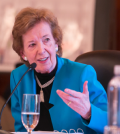
Mary Robinson
Former President of Ireland; Former UN High Commissioner for Human Rights; Chair of The Elders
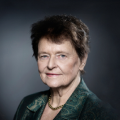
Gro Harlem Brundtland
Former Prime Minister of Norway; Former Director General of World Health Organization
Hazami Barmada
Host & Executive Producer, Finding Humanity Podcast; Founder, Humanity Lab Foundation
Key themes: International affairs, multilateralism, the United Nations, UN Security Council, COVID-19 global response, and how to curb existential threats including climate change and the threat of nuclear war.
Also available on:
In spite of the cards she was dealt, Nujeen was defiant and fought for a better future — eventually going on a 3,500 mile journey to escape the war in Syria on a wheelchair. In this episode, we'll hear about how Nujeen resettled as a student and activist in Germany, gaining global visibility as one BBC's 100 most influential and inspiring women for her refugee rights and disabilities advocacy. Through her story, we explore the migration of communities impacted by war and turmoil, as well as the grit needed to start a life in a new culture and community.
Nujeen Mustafa
Disability and Refugee Rights Activist; BBC's 100 Women 2018
Boram Lee
Disability advisor from the Women's Refugee Commission
Dr. Steven Heydemann
Director of Middle East Studies at Smith College in Massachusetts and a nonresident senior fellow at the Brookings Institution
Key themes: War in Syria, Disabilities, Humanitarian Action, Refugees, Migration.
Also available on:
How has the urgency of action needed for the Covid-19 response impacted our ability to focus on the climate agenda and development in the African context? How do female leaders deal with the demands of pressing global issues? Does women's leadership differ from leadership of male leaders?
Mary Robinson
Former President of Ireland; Former UN High Commissioner for Human Rights; Chair of The Elders
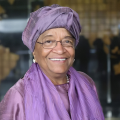
Ellen Johnson Sirleaf
Former President of Liberia and Africa's first elected female head of state; Nobel Peace Laureate
Hazami Barmada
Host & Executive Producer, Finding Humanity Podcast; Founder, Humanity Lab Foundation
Key themes: Women's leadership, women in policy making, feminism, COVID-19 response, and the progress of development in Africa and on the United Nations Sustainable Development Goals.
Also available on:
In this episode, we talk about key concepts and the impact of climate change on natural disasters, the responsibility of fossil fuel companies and what each of us can do to save our planet.
Marinel Ubaldo
Founder, Youth Leaders for Environmental Action Federation
Shyla Raghav
Vice President of Climate Change and Global Strategy at Conservation International
May Boeve
Executive Director of 350.org
Key themes: Climate Change, Youth Activism, Climate Action.
Also available on:
In this episode, two former presidents discuss conflict, climate, and the search for justice in the time of coronavirus. We will unpack ethics in times of war, the role of women in peace building, and what can be done to ensure vulnerable populations are not disproportionately impacted by disasters.
Mary Robinson
Former President of Ireland; Former UN High Commissioner for Human Rights; Chair of The Elders
Juan Manuel Santos
Former President of Colombia; Nobel Peace Laureate
Hazami Barmada
Founder & CEO, Humanity Lab Foundation
Key themes: Ethics and war, the role of women in peace building, how to ensure vulnerable populations are not disproportionately impacted by disasters and covid-19.
Also available on:
In this episode we discuss LGBTQ+ advocacy, human rights abuses and violations based on sexual orientation, and the importance of asking questions and creating spaces to discuss diversity and inclusion.
Abby Stein
Award-winning transgender rabbi, activist, speaker, and author
Idit Klein
President & CEO, Keshet, a national organization for LGBTQ equality in Jewish life
Zhan Chiam
Coordinator of the Gender Identity and Gender Expression Programme At at ILGA World (International Lesbian, Gay, Bisexual, Trans and Intersex Association
Key themes: The episode dives into topics including LGBTQI rights, human rights, gender quality, hate crimes
Also available on:
In this episode, we'll discuss justice, intersectionality and the COVID-19 response with two leaders at the forefront of defending human rights. We explore our responsibility toward the world's most vulnerable populations and how to ensure the COVID-19 response does not set back human rights trends globally.
Mary Robinson
Former President of Ireland; former UN High Commissioner for Human Rights; Chair of The Elders
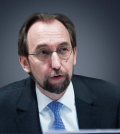
Prince Zeid Raad Al Hussein
Former UN High Commissioner for Human Rights
Hazami Barmada
Founder & CEO, Humanity Lab Foundation
Key themes: The episode dives into topics including Human Rights, Ethical Leadership & COVID 19.
Also available on:
We follow the story of Loung Ung, a human rights activist and author of the best-selling book "First They Killed My Father: A Daughter of Cambodia Remembers," which decades later was turned into a film by actor and filmmaker Angelina Jolie.
In this episode, Loung recounts her harrowing escape from terror and political instability as a child soldier, and how ultimately turned her trauma into activism.
Loung Ung
Author, Activist, Spokeswoman for the Campaign for a Landmine-Free World
Ben Kiernan
Founding Director of the Genocide Studies Program at Yale
Brad Adams
Executive Director of Humans Rights Watch Asia Division
Key themes: The episode dives into topics including forced displacement, war in Vietnam, crimes against humanity, and activism.
Also available on:
Our first episode takes us to Uganda, which has been plagued by civil unrest and rebellion since the 1980s. We dive into Victor's life, a young man, wise beyond his years, who refused to be enlisted as a child soldier. Growing up in between refugee camps, Victor was forced to confront his inner demons for survival, and won. Victor was hailed a hero for peace in his country, becoming the youngest ever African nominated for a Nobel Peace Prize in 2015.
The episode dives into topics including genocide, mass atrocities, child soldiers, peace and reconciliation.
Victor Ochen
Nobel Peace Prize Nominee, Founder and Executive Director for African Youth Initiative Network (AYINET), UN Goodwill Ambassador for Peace and Justice
Kristof Titeca PhD
Professor of International Development at the University of Antwerp
Sasha Lezhnev
Deputy Director of Policy at Enough Project, a nonprofit organization aimed at countering genocide and crimes against humanity
Key themes: The episode dives into topics including genocide, mass atrocities, child soldiers, peace and reconciliation.
Also available on:
More episodes coming soon Sign up to the newsletter to receive a message when new episodes are live. Sign up to the newsletter
Through real-life stories of courage and purpose, Finding Humanity takes listeners into the heart of the most complex social and political issues facing our world. By bringing you voices from the front lines of war and injustice, host Hazami Barmada peels back the layers that surround today's massive challenges.
Each episode puts a human face on a global topic that is overwhelming and difficult to grasp— be it the refugee crisis, climate change, or LGBTQ discrimination. While set in unfamiliar places, Finding Humanity tackles recognizable themes: love of family, finding hope, and overcoming personal struggles. Our podcast weaves insights from human rights and development experts at the United Nations and leading institutions, while providing listeners with tangible steps to make a difference.
Finding Humanity is a joint production of the Humanity Lab Foundation and Hueman Group Media. Our inaugural season is made possible in part by our collaborating partner, The Elders.
Finding Humanity inspires the activist in each of us, to create a better tomorrow, today.
The Humanity Lab Foundation is an innovative non-profit movement-building organization that harnesses the power of empathy and people to drive social change. The Humanity Lab works to realize the untapped capacity and passion of every-day people to be partners in solving complex global issues. Through the 3 pillars of it's work (creative, education, engagement), the Humanity Lab aims to disrupt the status quo in global development to catalyze sustainable change.
By leveraging technology, in partnership with the United Nations Office for Partnerships and the Office of the President of the United Nations General Assembly, the Humanity Lab hosted the first ever virtual Summit during the United Nations General Assembly (Global People's Summit) with the mission of "democratizing access to convesations that shape the world".
Hueman Group Media ("HGM") is an award-winning podcast company for social change. HGM produces impactful and high-caliber podcasts for leading nonprofit organizations, purpose-driven companies and thought leaders, amplifying conversations around today's most important causes and issues — including gender inequality, climate change and mental health. HGM podcasts cater to diverse, socially conscious and deeply curious audiences. With the power of storytelling and riveting conversations, HGM activates listeners to take action and make a positive impact in their communities.
Founded by Nelson Mandela in 2007, The Elders are an independent group of global leaders working together for peace, justice and human rights. Currently chaired by Mary Robinson, a former President of Ireland and UN Human Rights Commissioner, their vision is of a world where people live in peace, conscious of their common humanity and their shared responsibilities for each other, for the planet and for future generations.
They work both publicly and through private diplomacy to engage with global leaders and civil society at all levels to resolve conflict and address its root causes, to challenge injustice, and to promote ethical leadership and good governance. Their key areas of work include Climate Change, Nuclear Non-Proliferation & Disarmament, Conflict, Universal Health Coverage, Access to Justice and Refugee & Migration.
Hazami Barmada is a thought-leader, seasoned global strategy consultant, social innovator, and international public speaker. Hazami advises governments, businesses and organizations on design and implement effective social impact strategy, public-private partnerships, public affairs strategy. Prior to founding the Humanity Lab Foundation, she held several positions at the United Nations, including the Coordinator for the United Nations Secretary General's World Humanitarian Summit, global engagement and communications head for the UN Secretary-General's Envoy on Youth, and innovation advisor to United Nations Human Settlements Programme. Hazami has a Masters in Public Administration from Harvard University where she was also a Fellow in Public Policy and Management at The Harvard Kennedy School of Government. She is a Presidential Leadership Scholar and was described in Forbes as an "inspirational change agent".
How This Woman Is Mobilizing Millions Of Global Change Makers
Help us inspire the activist in each of us, to create a better tomorrow, today! Every contribution helps!
Support the podcast on Give LivelyPlease reach out to us if you want to get involved, to support the project, for sponsorship, advertising opportunities or guest pitches.
Send us an email Download the press release You can also find us on: Facebook, Instagram and Twitter